Beyond the Post: How a Multi-Channel Digital Strategy Drives Real Foot Traffic for CRE Properties
By Jackie Dean, Co-Founder & CEO of Dean&Co
There's a persistent myth floating around the commercial real estate world. It goes something like this: "If we post on Instagram a couple of times a week, people will show up."
We respectfully (but firmly) challenge that.
Posting content is not a strategy. It's a starting point. And in today's attention economy, starting points don't fill parking lots, drive restaurant covers, or build the kind of community loyalty that keeps a retail center relevant year after year.
What does? A deliberate, multi-channel digital marketing strategy. One where every post, every ad, every email, and every search listing is working together toward one goal: getting people off their screens and through your doors.
At Dean&Co., that's exactly what we build.

Strategy First. Everything Else Follows.
Before a single post goes live, a single ad gets served, or a single email hits an inbox, there needs to be a strategy document. Not a vague content plan. Not a mood board. A real, working strategy that answers the fundamental questions:
Who are we talking to and who are we not talking to?
What do we want people to do as a result of our marketing?
What does this property stand for, and how do we communicate that consistently?
Which channels are right for this audience, and what role does each one play?
How do we measure success and what does success actually look like?
A strategy document is the north star for every marketing decision. It defines brand voice and tone, establishes content pillars and buckets, outlines the channel mix, maps the customer journey, sets campaign objectives, and aligns all activity to measurable business goals.
Without it, you're just creating content and hoping for the best. With it, every marketing dollar and every creative decision has a job to do.
“Strategy without tactics is the slowest route to victory. Tactics without strategy is the noise before defeat.”
For commercial real estate properties specifically, a strong strategy document accounts for the seasonality of retail, community events, and the unique draw area of each property. A neighborhood lifestyle center plays a completely different game than a regional power center and their marketing should reflect that.
The strategy is what makes the rest of this work.
The Numbers Don't Lie
We talk about impact. Let's show it.
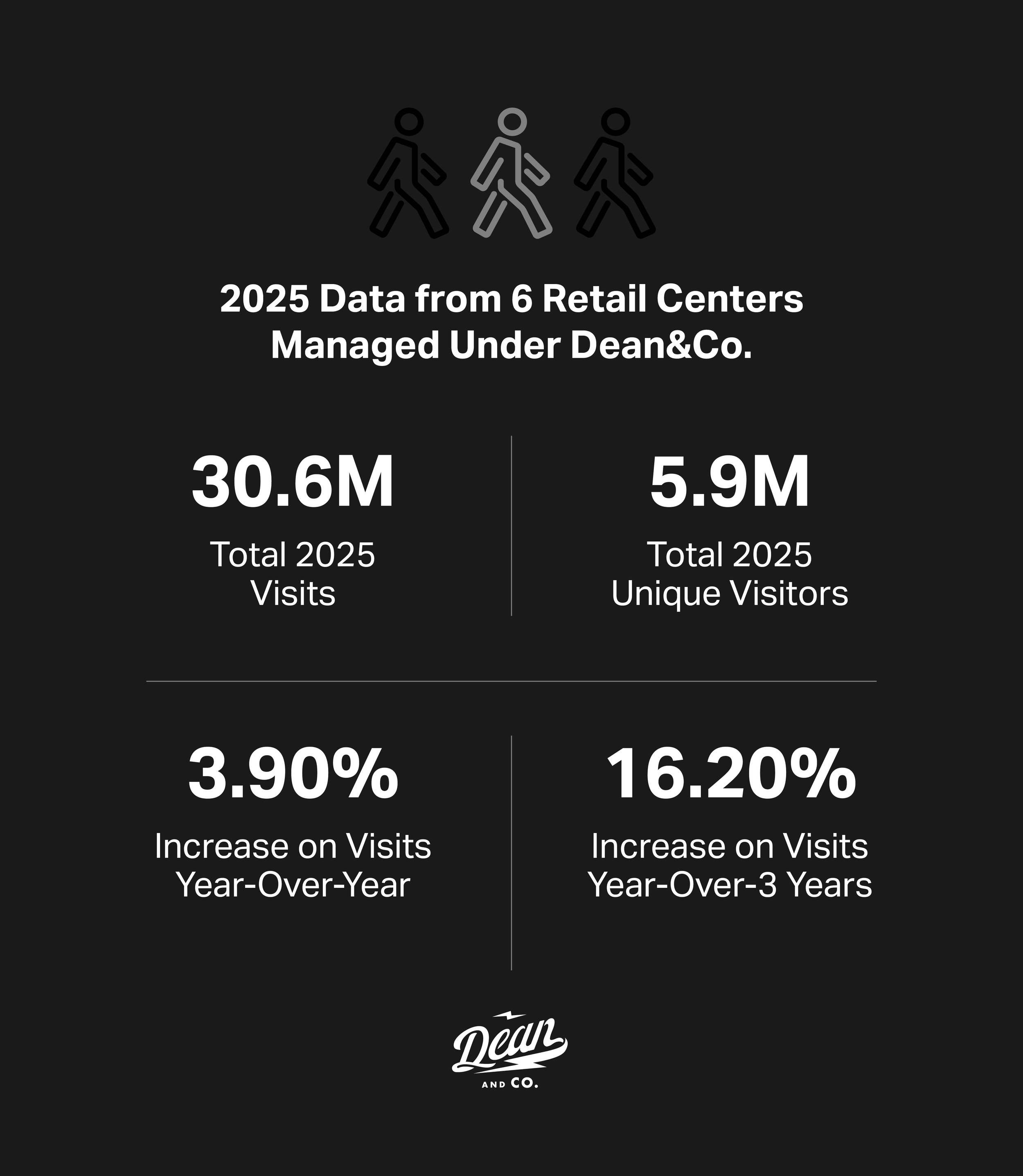
Across 6 retail centers managed under Dean&Co.'s digital marketing strategy in 2025, here's what the data looks like:
30.6M Total 2025 Visits
5.9M Total 2025 Unique Visitors
3.90% Increase on Visits Year-Over-Year
8.96% Increase on Visits Year-Over-2 Years
16.20% Increase on Visits Year-Over-3 Years
And on the digital side, the social media numbers behind those properties:
8.7M Total Reach
3.5M Total Views
We want to be straightforward here: we're not claiming that digital marketing is solely responsible for 30.6 million visits. Foot traffic is influenced by many factors: tenant mix, macroeconomic conditions, local events, seasonality, and more.
But consistent, year-over-year growth in visits by 3.9% annually, nearly 16% over three years doesn't happen by accident. It happens when communities stay engaged, when properties stay top of mind, and when the right marketing reaches the right people at the right moment.
An 8.7-million-person reach and 3.5 million views aren't vanity metrics. They're touchpoints. And touchpoints build familiarity. And familiarity builds visits.
“Dean&Co. doesn’t just design pretty things. They think like owners. They talk asset strategy, long-term positioning, and traffic growth. The stuff that moves NOI.”
Organic Social: The Foundation, Not the Finish Line
Organic social media is where your property's identity lives. It's how you show up for the people who already know you, build community with locals, spotlight your tenants, and give people a reason to keep paying attention.
Done well, organic content does several things simultaneously:
Reinforces brand voice and visual identity
Builds trust and community with your existing audience
Creates shareable moments that extend reach without paid spend
Feeds the algorithm with consistent engagement signals
But here's the honest truth: organic reach is not what it used to be. Platform algorithms continue to limit how many of your own followers see any given post. That means the community you've worked hard to build often isn't even seeing what you're publishing.
Organic is the foundation. It is not, and has not been for years, a complete strategy on its own.
“Dean&Co.’s work has brought tremendous value to our assets, and their team continues to create the community that drives our projects!”
Paid Advertising: How You Reach the Right People
This is where intentional strategy separates the properties that grow from the ones that plateau.
Paid social and search advertising is not a "boost post and hope" exercise. It's a precision tool and when used correctly, it puts your property directly in front of the people most likely to visit, engage, and become regulars.
Why Advertising Is Non-Negotiable
Organic reach on Meta platforms has declined sharply over the past five years. Studies consistently show that organic posts reach only a small fraction of a page's total audience.

Paid advertising bridges the gap between content you create and audiences you haven't reached yet. For commercial real estate, the stakes are especially high. You're not selling a product that ships to a doorstep. You're selling a destination. The person has to physically show up. Which means the targeting has to be right.
Targeting: Where Money Becomes Investment
Bad targeting is how good budgets disappear. Great targeting is how a modest budget outperforms a bloated one.
Here's what thoughtful audience targeting strategy looks like for CRE properties:
Geo-Targeting
Marketing a retail center in Raleigh, NC to someone in Rochester, NY is wasted spend. Campaigns are built around real drive-time radii, typically 5, 10, and 15-mile rings depending on property type and draw area. For restaurants and daily-needs retail, the radii gets even tighter.
Demographic & Behavioral Targeting
Who shops here? Who eats here? Who brings their family here on weekends? We build audience profiles based on age, household income, lifestyle interests, and shopping behaviors, then match creative to the audience. A campaign targeting young professionals looks very different from one targeting families with kids.
Retargeting & Custom Audiences
We can serve ads to people who have visited your website, engaged with your social content, or physically visited your property (using location data) or a competitor nearby. This is precise, powerful, and often the most cost-efficient targeting available.
Google Ads & Search Intent
When someone searches "restaurants near me" or "things to do in [city] this weekend," they're telling you exactly what they want. Google Ads puts your property at the top of that search at the exact moment of intent. Paired with a well-maintained Google Business Profile, your property becomes the answer to questions people are already asking.
Email Marketing: Your Most Underestimated Asset
Every agency will tell you social media is important. Fewer will tell you this:
Email marketing consistently delivers the highest ROI of any digital channel and for commercial real estate brands, it's particularly powerful.
“Email has an average ROI of $36 for every $1 spent.”
Here's what makes email different from every other channel in your mix:
Email subscribers are not casual followers. They opted in. They raised their hand and said, "Yes, I want to hear from you." That level of intent puts them in a fundamentally different category than someone who stumbled across a social post.
Email subscribers are further down the funnel. They already know your property. They already have a baseline of trust and interest. What they want is more — more information, more value, more reasons to engage. Email is where you give them that.
You own the list. Social algorithms shift. Platforms evolve (and occasionally face existential crises). Your email list belongs to you. That's an audience asset that no platform update, policy change, or algorithm overhaul can touch.
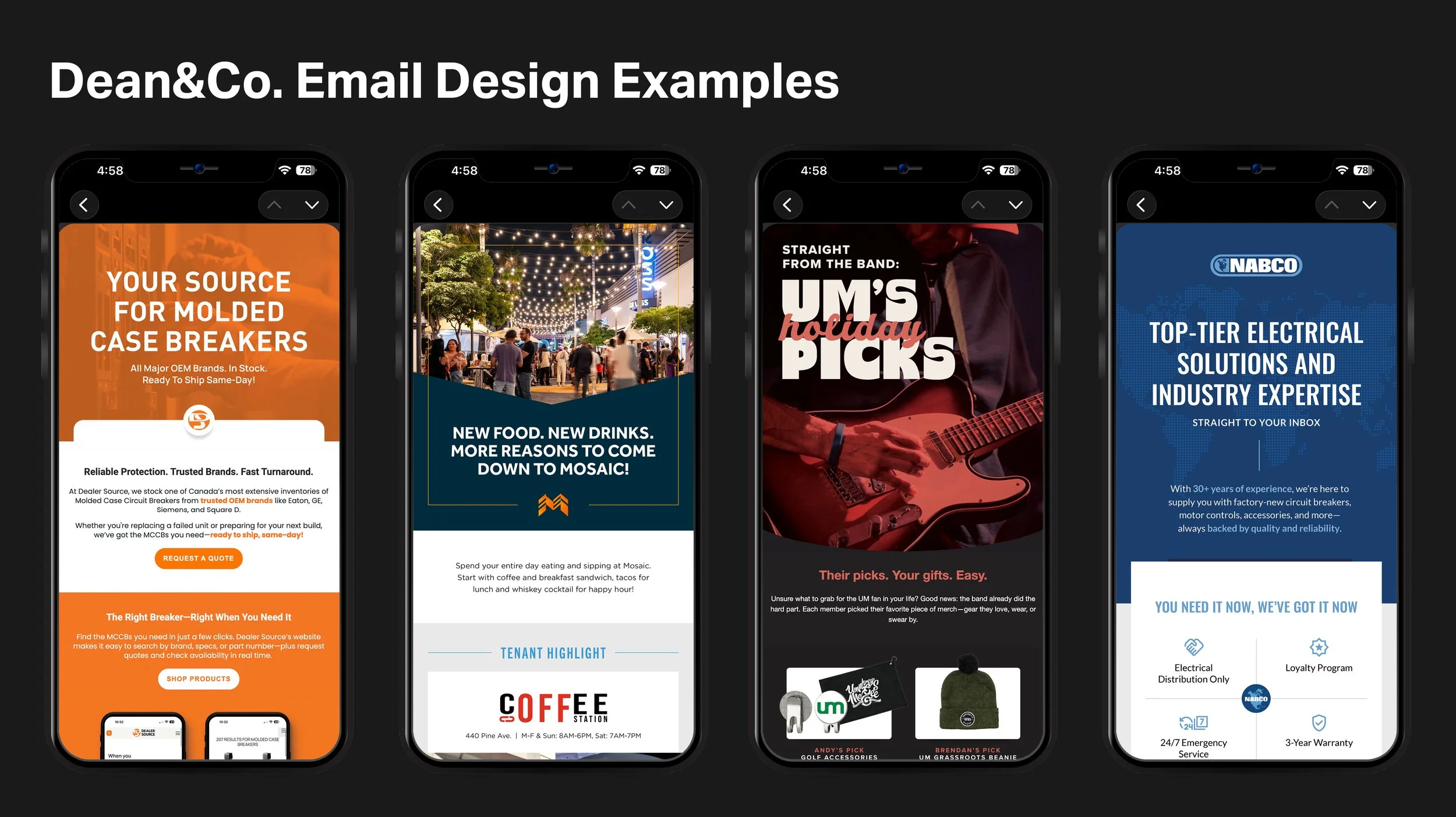
Email is where action happens. Flash sales, tenant grand openings, event early access, leasing updates, community news — email is the channel where you can go deeper, say more, and move people to act.
What a Strong Email Strategy Looks Like
Consistent newsletters (monthly or bi-weekly) featuring property news, tenant spotlights, and upcoming events
Event-driven campaign sequences — save the date → early access → reminder → day-of → recap
Segmented sends based on subscriber type and interest (community visitors vs. prospective tenants, for example)
Automated welcome sequences for new subscribers that establish value immediately
List health management — because a smaller, engaged list will always outperform a bloated, disengaged one
The goal isn't to flood inboxes. It's to show up with enough value and enough consistency that your subscribers actually look forward to hearing from you.

AI, Search, and Why Keywords Are No Longer Optional
Here's something that's changed dramatically, and quietly, over the last couple of years: how people find places.
The search bar used to be a Google thing. Type in a query, scroll through blue links, pick one. That was the game. And while Google is still enormously important (more on that in a moment), the way people discover restaurants, retail centers, and local destinations has expanded in ways that have real implications for how commercial real estate properties need to show up online.
AI-powered search is here, and it's reshaping discoverability.
Tools like Google's AI Overviews, ChatGPT, Perplexity, and other AI search platforms are now answering people's questions directly; pulling information from websites, reviews, social profiles, and business listings to surface recommendations without requiring someone to click through a dozen links. When someone asks an AI assistant "What's a good shopping center near me with local restaurants?" or "Where should we take the kids this weekend in [city]?" — the properties that show up are the ones that have been built to be found.
That's not an accident. It's infrastructure.
Keywords: Still the Foundation, Now More Important Than Ever
Strategic keyword usage isn't an SEO technicality, it's the language your audience is already using to look for you. If your website, Google Business Profile, social captions, and your email content don't reflect the words and phrases real people type into search bars (and ask AI assistants), you're essentially invisible to them.
For commercial real estate properties, this means being intentional about:
Local search terms — "retail centers in [city]," "restaurants in [neighborhood]," "things to do near [landmark]"
Experience-based language — "family-friendly," "outdoor dining," "local boutiques," "weekend activities"
Tenant and category keywords — the specific types of businesses, cuisines, and services your property offers
Event-driven keywords — "farmers market [city]," "live music [area]," "holiday shopping [region]"
These keywords should live everywhere: your website copy, meta descriptions, blog posts, Google Business Profile updates, social captions, and email subject lines. Consistency across channels signals relevance to both search engines and AI platforms.
Your Google Business Profile Is a Search Asset
A Google Business Profile that's incomplete, outdated, or unmanaged isn't just a missed opportunity. It's actively working against you. In an era where AI pulls from structured business data to answer local queries, your GBP is one of the most powerful pieces of real estate (pun fully intended) you own online.
That means keeping hours current, responding to reviews, posting updates regularly, uploading fresh photos, and using keyword-rich descriptions that accurately reflect what your property offers. Google rewards active, well-maintained profiles with better visibility. AI tools reward structured, credible, consistent information.
What This Means for Your Property
The properties that will win the next phase of digital discovery aren't necessarily the ones with the biggest budgets. They're the ones that have invested in being findable, through smart website structure, consistent keyword strategy, active business listings, and content that answers the questions their audience is already asking.
Digital marketing and SEO/AI searchability aren't separate disciplines anymore. They're the same conversation.
Digital Marketing Is Powerful. It's Also Not Everything.
We'd be doing you a disservice if we didn't say this plainly: digital marketing is a critical piece of the puzzle, not the whole puzzle.
The most successful commercial real estate properties we work with aren't just running great digital campaigns. They're also showing up in the physical world in ways that digital alone can't replicate.
That means:
A community events calendar that gives people recurring, tangible reasons to visit: markets, concerts, pop-ups, seasonal activations
Relationships with local organizations, schools, and community groups that root the property in the fabric of the neighborhood
On-site signage and touchpoints that convert visitors into digital followers and email subscribers: QR codes, sign-up prompts, social handles that are actually visible and legible
Tenant engagement supports your tenants' marketing efforts, not just your own property's
Digital marketing can reach people, inform people, and motivate people. But community-building keeps them coming back. The properties that see sustained, compounding growth are the ones treating digital and on-the-ground efforts as partners, not substitutes for each other.

Why Dean&Co.?
A lot of agencies can post content. Fewer understand what it means to market a place.
We specialize in commercial real estate and the built environment; retail centers, city districts, restaurants, regional communities. It's not a vertical we dabble in. It's the only one we're in. Which means we understand your tenants, your draw area, your seasonality, and the unique pressure of marketing a destination that people have to physically choose to visit.
We're not a vendor you check in with quarterly. We're a strategic partner that's as invested in your property's performance as you are, because your numbers are our numbers, and we take that seriously.
Our work spans organic social management, paid social advertising, Google Ads, Google Business Profile management, and email marketing, all working together under one integrated strategy, built specifically for your property.
The difference between a property that plateaus and one that grows isn't luck. It's strategy.
Ready to build a strategy that actually moves people? Let's talk.
© Dean&Co. | deancostudio.com